
March 8 Update: All sub responses have been sent!
Hello all,
We just finished responding to all of our remaining submissions today, Sunday, March 8, 2026. We thank you for your patience!
If you sent a submission within our window of January 1-10, 2026, and you have not received a response, please feel free to reach out to us through our Contact form or by dropping us an email at 34orchardjournal@gmail.com.
Stay tuned! We’ll be announcing our ToC for the Spring 2026 issue soon!
Kristi
March 2 Update: Thanks for your patience!
Hello all,
Our response deadline is February 28. Due to staff illness and personal situations we are running behind, and still have about 125 pieces to finish considering. If you have not heard back from us, it means your work made it to our final rounds of consideration.
We are completing our selections as quickly as we can! Thank you for your understanding, and if you have any questions or concerns, please reach out to us at 34orchardjournal@gmail.com.
I’m hopeful all of our responses will be sent by March 8.
Kristi
“Fiction was invented the day Jonah arrived home and told his wife that he was three days late because he had been swallowed by a whale… ”
Gabriel García Márquez
What’s the Deal with Second Person?
Who remembers the excellent Choose Your Own Adventure book series? Penned in second person, these little books allowed young adult readers to visit space, time travel to the dinosaurs’ last day, battle Bigfoot or even cruise on the Titanic or climb Mt. Everest. As a kid, I loved them—and it’s probably why I love the second person rendering so much today.
We get mail expressing surprise we’re so open to it—there is at least one second person narrative in most of our issues; in some instances, two. While I consider second person akin to the found footage subgenre—you’re either into it, or you’re not—I think the point of second person POV gets misconstrued.
In my opinion, second person POV isn’t meant to put readers in the shoes of the narrator, although that can sometimes occur. It’s to make readers feel uncomfortable in a way other POVs can’t:
Readers are being watched. In a solid piece, it almost feels as though a ghost is talking directly to readers. While it’s been cited this creates distance between readers and the material, on the contrary: this makes readers feel like they’re being watched, adding unwritten tension.
Readers are watching. Enter the found footage aspect. A well-executed second person narrative makes readers feel as though they’re eavesdropping; watching something they shouldn’t. It’s voyeurism at its finest when done right, making them feel guilty yet helpless to resist.
We receive only a handful of second person pieces, and although we love it, it’s a tough sell even for us. While many factors go into choosing a story for publication—and most of the time it’s not due to quality—second person POV is an exception.
For us, the most common reasons a second person narrative falls flat are:
Too long. Second person creates awesome tension—but it can’t be sustained over a too long a text; just like an overly passionate relationship, anything that intense has a shorter burn time. For second person, shorter is better. There can be exceptions to this—we’ve found a couple of longer ones that succeed, and there are probably novels out there that work, too. But on the whole, a good rule to follow is short.
Used as gimmick. Second person has to serve a purpose, meaning it’s being used to evoke a strong emotional response such as paranoia, fear, or transgressionary guilt. If the story would feel the same in first or third person, second person isn’t the thing to use (this is a good litmus test). The risk of using second person as a gimmick is that the story feels thin at best and boring at worst—but either way, it doesn’t engage the reader.
Slow pacing. The whole point of second person is to keep that tension taut, and so the pacing has to move at a good clip. Many times, second person pieces have extraneous scenes or low-temp situations that slow the story down.
An excellent example of expertly-rendered second person is Aura, by Carlos Fuentes. https://www.amazon.com/Aura-English-Spanish-Carlos-Fuentes/dp/0374511713/
Other than that, here’s a list of the second person pieces appearing in our pages:
Tales from a Communion Line, Yash Syedbagheri
Like it’s a Mad Thing – Lee Ann Kostempski
Carrion – Ellen Anderson
Phantom Touches – Amar Benchika
The Days Before – Stephanie Lennon
In the City of Floating Wolves – Tara Campbell
Of Ink and Blood – Kevin M. Casin
Little Red – Paula Weiman
A Cracked Screen – Alice Avoy
Memory Foam – Rowan Hill
The Flute – Ernest O. Ògúnyẹmí
How to Make a Vase – Kieran Thompson
Meeting Mary Bloody Thighs in a Convenience Store in Arkansas—Josie Levin
Keepsake Box – Lynn Wiser
…and look forward to more in 2026 and 2027!
Thanks for reading,
Kristi
34O is now a member of CLMP!
IT’S OFFICIAL! 34 ORCHARD is now a member of the CLMP (Community of Literary Magazines and Presses). The Community of Literary Magazines and Presses is a network of small, independent publishers who work together to support diverse writers, connect them with readers, and strengthen literary culture. They view publishing as a creative practice rooted in mutual support and community, and they actively engage everyone who cares about literature to ensure independent publishing continues to thrive.
We’re looking forward to participating and sharing and being part of something larger than us in helping keep great art in the world.
To learn more about their important work and what they’re about, visit here: https://www.clmp.org/about/what-we-believe/
I couldn’t be more thrilled about being part of a community that shares information and resources so that we can continue to provide high quality literature to our readers.
CLMP showcases many independent publishers of books and lit mags on their social media. If you love indie, we recommend following them on Insta to stay abreast of what’s out there.
“Only those things are beautiful which are inspired by madness and written by reason.”
Andre Gide
Watch out for scams targeting short story writers/poets!
Much has been written about scams targeting writers, and while there have been many over the years—from When Words Count to the National Library of Poetry to PublishAmerica—a whole new crop has sprung up and become more prominent in the past year. These are invitations to have your book featured in book clubs, reviewed or endorsed by famous authors, or appear at literary festivals. I’m sure there are more iterations, but that’s the idea. This article on Writer Beware goes into more detail: https://writerbeware.blog/2025/11/14/if-a-famous-author-calls-hang-up-anatomy-of-an-impersonation-scam/
I had heard of many of my peers receiving scammy emails, texts, and phone calls, but it only happened to me just recently (two on the same day)–and now they’re targeting not just people who have books for sale, but short story writers and poets who are featured in anthologies. If anyone receives these, they are scams. Don’t respond:
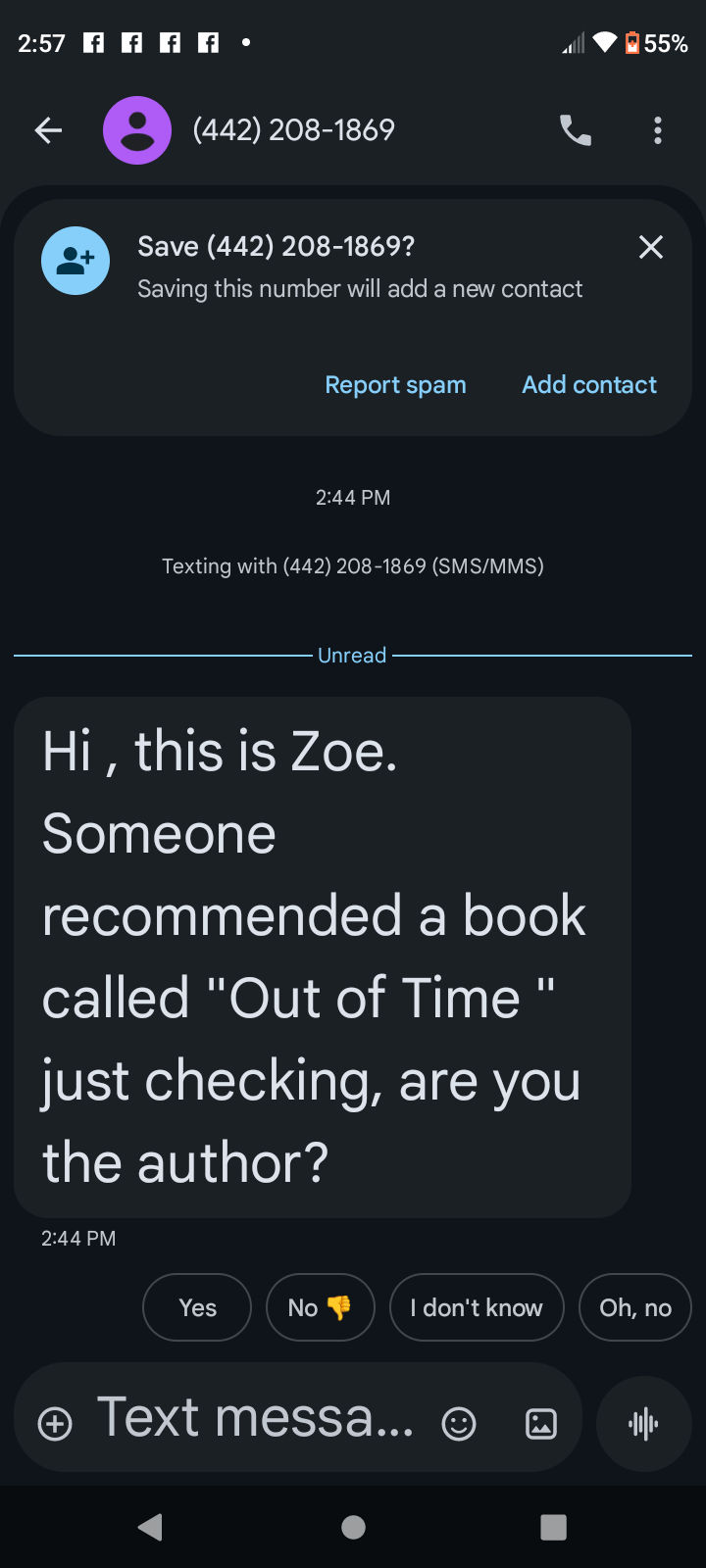
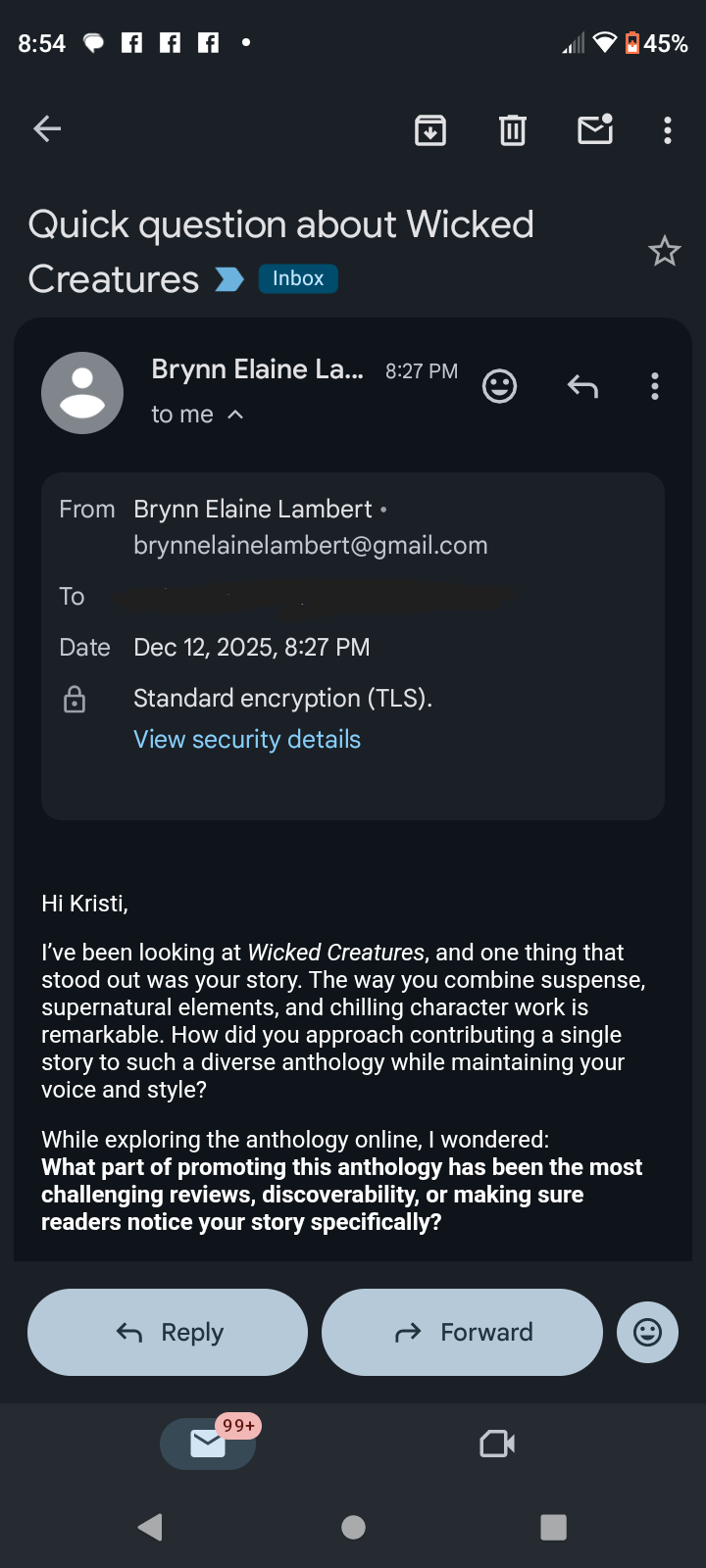
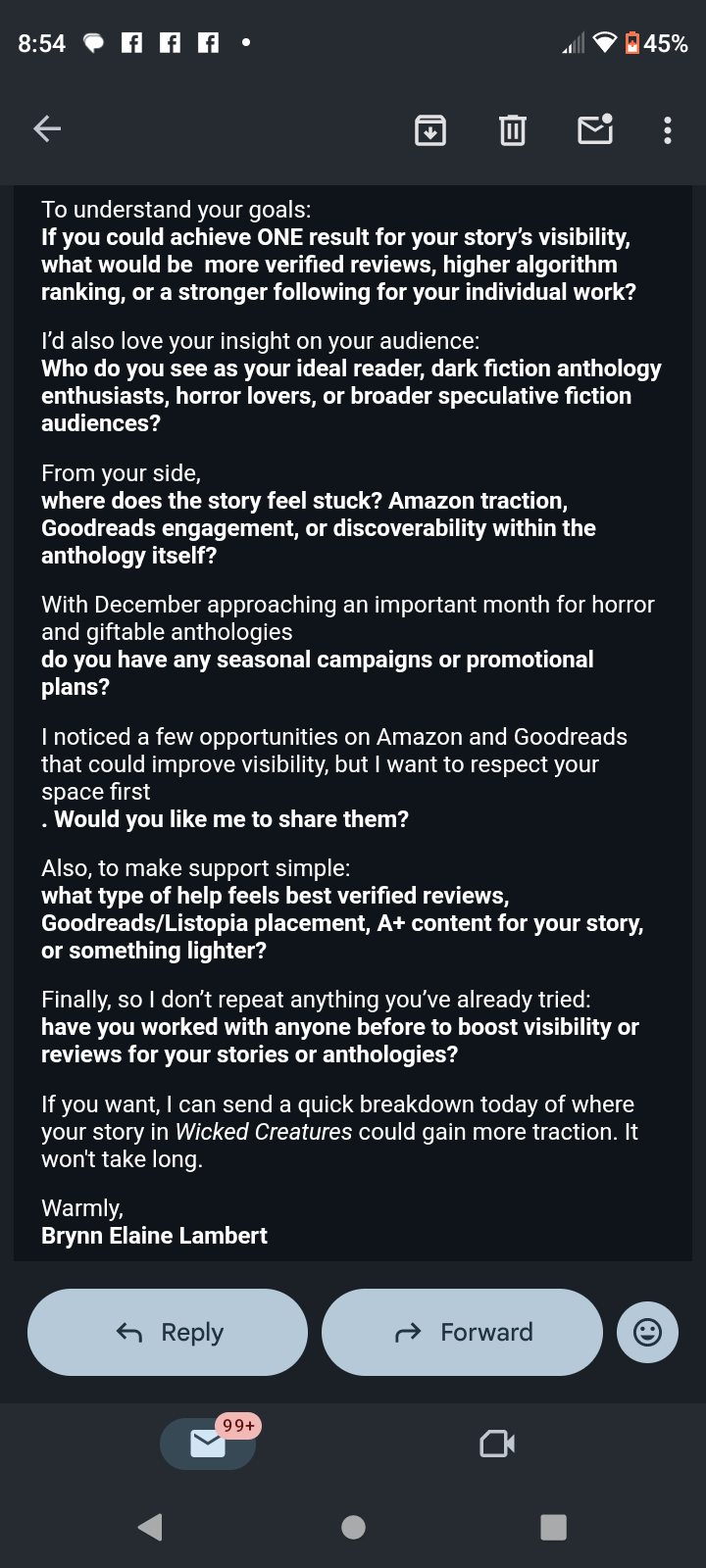
Absolute Write Water Cooler is a great place to check for what’s scammy and what’s not. Here’s the link to their Bewares & Background Checks forum space: https://absolutewrite.com/forums/index.php?forums/bewares-recommendations-background-check.22/
Our submissions window is now closed!
Our submissions window is now closed. Thank you to all who submitted! That so many writers would love to be in our pages is an honor, and we appreciate every single submission, even if we don’t publish it.
If you haven’t received a response yet, we are working on it—we go as fast as we can so that your work isn’t sitting in our inbox eating up time it could be under consideration at another market that may not accept simsubs. We aim to have all responses sent out no later than February 28.
We’ve got some stellar selections for this year, so if you’re also a reader, you have much to look forward to!
In January of 2027, we plan to be open for fiction and poetry.
If you have any questions or concerns and need to contact us, you can either reach out to us through the form on our Contact page or email us at 34orchardjournal@gmail.com.
We wish you a productive, healthy, exciting 2026!
In gratitude,
Kristi and Anne
Ring in the New Year! Our submissions window is now open!
Submissions for SHORT FICTION are now open! The window will close at 11:59 pm your local time on Saturday, January 10, 2026.
We are considering fiction pieces for our Spring and Autumn 2026 issues from 1000 to 6000 words. Please note, we are not accepting poetry submissions this time around. We will welcome poetry again in January of 2027.
We do our best to respond as quickly as we can, and aim to have all responses sent out no later than February 28.
Our guidelines are here: https://34orchard.com/guidelines/
If you have any questions or concerns and need to contact us, you can either reach out to us through the form on our Contact page or email us at 34orchardjournal@gmail.com.
 34 Orchard